
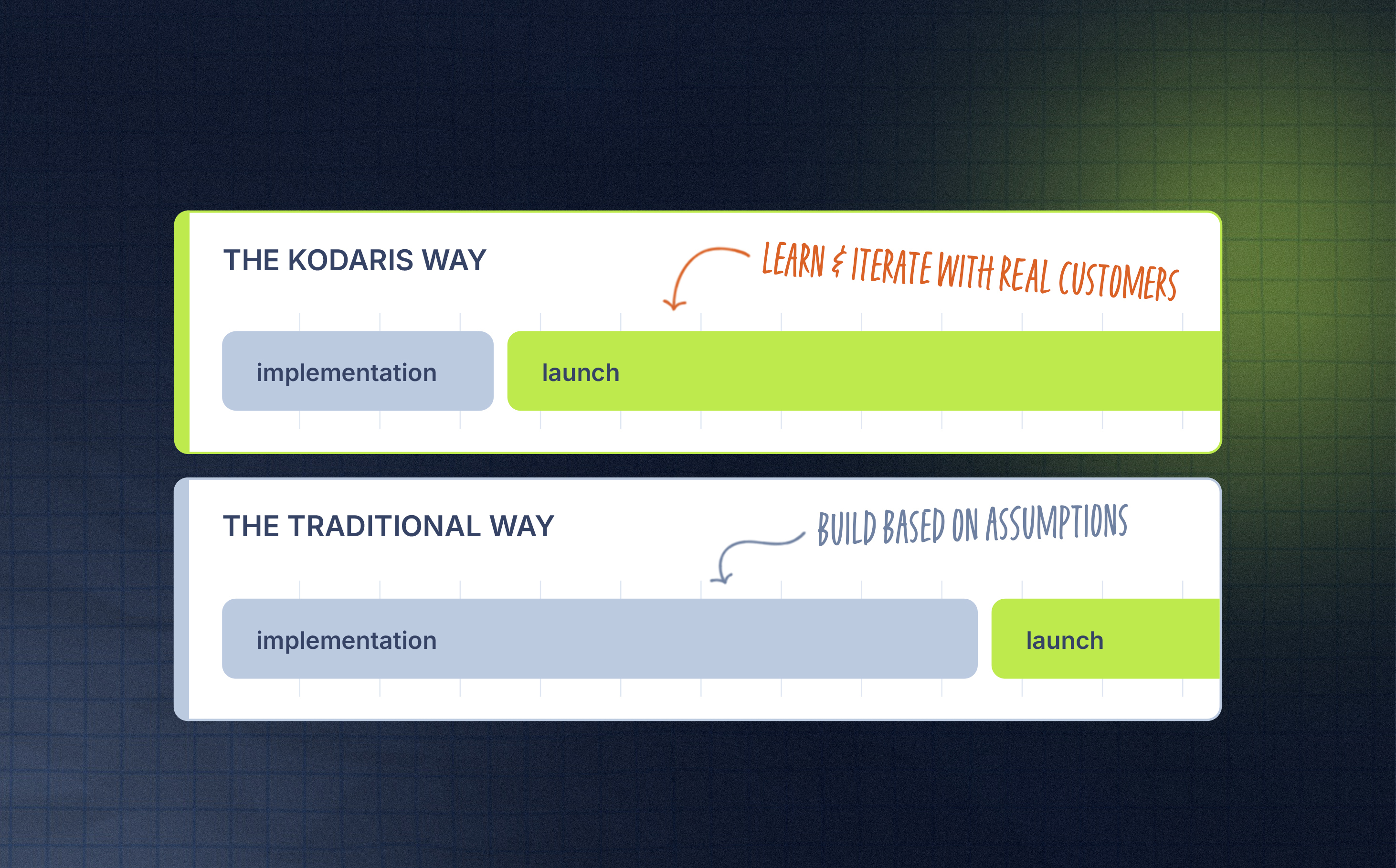
We recently worked through a conversation with a potential customer evaluating Kodaris for a Commerce implementation. When they received our services quote, they were skeptical. Our number was 70% lower than what other providers had quoted for the same project.
Their first assumption was that there must be hidden costs. Fine print. Something they weren't getting. It was an interesting conversation because the difference was the thought processes on how implementation should work.
The traditional implementation approach goes something like this. A provider comes in and treats the project like an agency engagement. They quote you $100,000. They interview your employees and your customers. They build out a full digital plan. They produce mockups, flows, and documentation. They design what it should look like and why before a implementation started or configured and then they implement all of it.
Nine months to a year later, you launch. You've spent a significant budget on services, you've had your own team invested throughout, you've been paying for the solution the whole time, and now you're finally starting to gauge whether any of it was right: whether the ROI you projected is materializing, whether the market has shifted since you started, and whether your customers' needs are the same as they were when you planned it.
At Kodaris we took a different approach. The reason we do it differently comes from watching the market and learning from experience. The longer you are not in front of actual users, the more risk you are carrying.
Kodaris gets you functional quickly with solid base implementation. We do focused work with you on exactly what you need to launch. That doesn’t necessarily include everything you might eventually want, but enough to get in front of users.
That timeline is roughly 2 to 3 months to get to internal testing, then live in front of real users. Once real users are in the system, real learning begins. We talk through what works, what needs to be adjusted, what features matter versus what you thought would matter, and what needs to be tweaked to fit your standard operating procedures.
That's when you start spending based on what you know rather than what you or your agency is assuming. After launch, you build in time to learn. Maybe you run for 3 months and compile your list before changing anything. Maybe there's an immediate priority that surfaces from user behavior. Either way, you're making those decisions with real data and user experience instead of projections.
Even a $100,000 implementation isn't going to be perfect at launch. Every software project iterates after go-live, but with a 12-month pre-launch engagement, you're iterating on assumptions. With the Kodaris model, you're iterating on real user behavior as quickly as you can get a base system live.
The faster your customers and internal users have the system in their hands, the faster you know exactly what's driving ROI and what isn't and the faster you can direct your investment toward what actually matters versus what was an educated guess made before anyone had seen the product in action.
That's what time to value (TTV) means in practice. Every month before launch is a month you're spending without receiving a return. The shorter that window, the faster your investment starts paying back.
When we explained this to the customer who was skeptical of our quote, the concern made sense. In most industries, significantly lower pricing means something is missing. In implementation services, it often means a different model. Lighter upfront planning, faster time to launch, real-world iteration rather than pre-launch speculation.
The approach that seems safer, the long agency-style engagement with extensive planning before implementation, carries a larger risk of failure rate and more dollars at risk. We know this from watching what happens. When needs change, when markets shift, when planning takes longer than expected, those projects compound in cost and delay.
Kodaris customers are happier with the faster model. They're using the platform sooner. They're collaborating on improvements based on what they actually see. And they're not waiting on a year of planning to find out whether they made the right choice.
Time to value is critical for project success. It's worth thinking about when you're comparing quotes. If you’re ready, reach out to our team and we can share more about our approach.